
WHY A SPRING REQUEST IS TOO LATE FOR SUMMER BREAK CONSTRUCTION.
Every spring, schools start reaching out with the same urgent question: Can we still get this project done over the summer?
Whether the need is a playground upgrade, parking lot improvement, athletic field renovation, stadium improvement, accessibility update, drainage fix, or building addition, the challenge is often the same: by spring, the summer schedule is already working against you.
And the majority of the time, the answer is no. Not because the project is not important.
Because by the time a spring request is made, the summer school construction window is usually already full.
For education projects, spring can feel like the right time to request summer construction. Students are nearing the end of the year, campus access will soon be easier, and the summer window feels close. But getting work approved, contracted, scheduled, and built takes more runway than March and April can provide.
The Summer Construction Window Is Shorter Than It Looks
Most school construction projects and education facility improvements need to happen between the end of the school year and the return of students, staff, athletics, and daily campus operations. In many cases, that leaves only 8 to 10 weeks.
That is the whole window.
And even that window can shrink quickly.
Graduation may delay mobilization. Protective fencing has to be installed. Equipment and materials need to be delivered. Permits may still need final approval. Contractors need crews scheduled. Bonding and insurance need to be in place. Long-lead materials may need to be ordered before anyone can break ground.
So while construction may happen in June, July, and early August, successful summer school construction planning starts long before then.
Why March and April Are Usually Too Late
By spring, qualified contractors are already building their summer schedules. The best teams are not waiting around with open crews, available equipment, and a wide-open calendar.
They are already committed.
That creates a hard reality for schools trying to move quickly. If a project still needs land surveying, civil engineering, utility coordination, drainage review, construction documents, jurisdictional approvals, proposal solicitation, contractor selection, contracts, permits, and construction staking, there may not be enough time left to complete the work that same summer.
And if someone is still wide open in April and promising they can get it done before school starts, it is worth asking why.
That does not automatically mean they are the wrong fit. But it does mean the project team should understand the risk before committing to a schedule that may already be working against them.
Summer School Construction Starts in the Fall
If the goal is to complete school improvements next summer, the planning needs to start the fall before.
A stronger timeline looks like this:
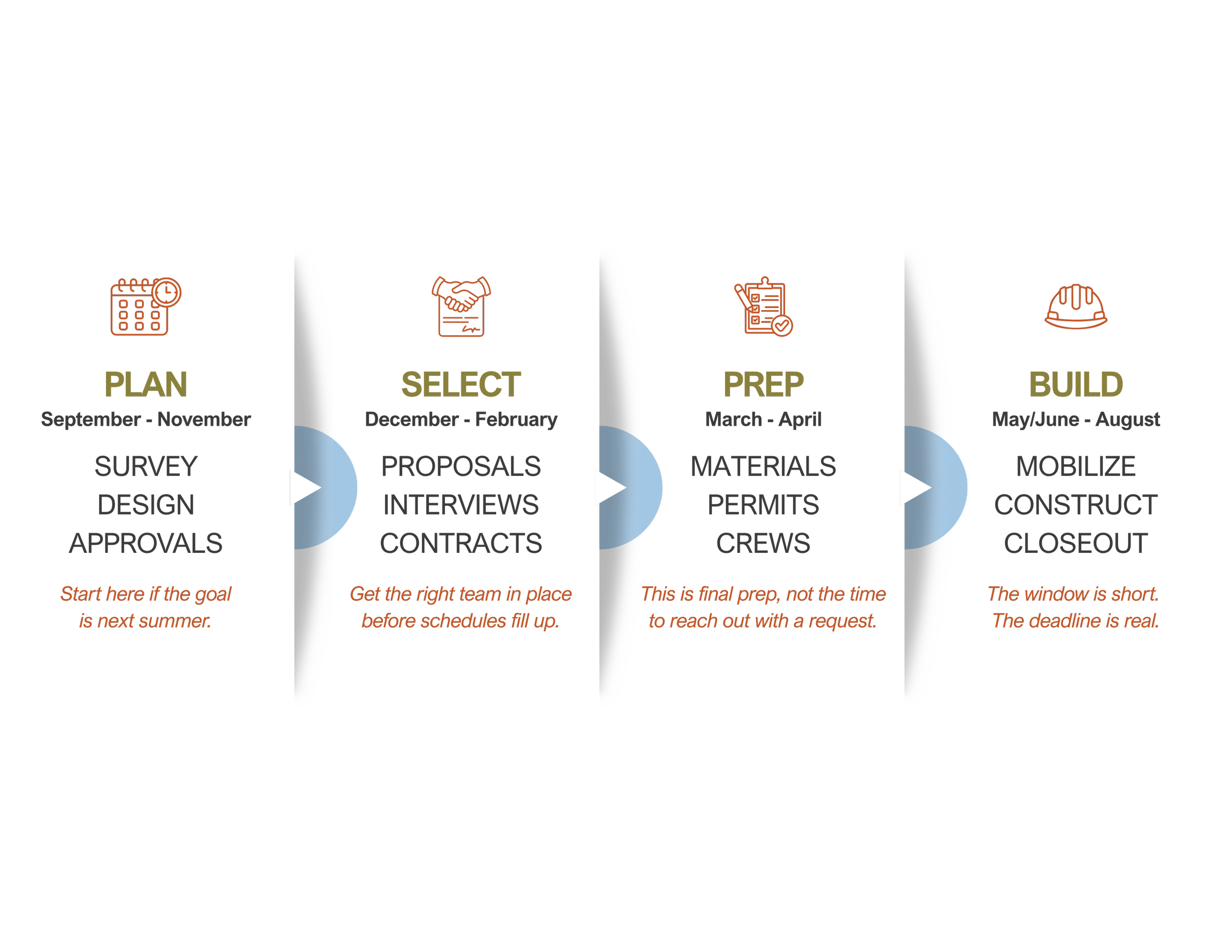
For school construction projects, summer is the build window, not the planning window. Starting in the fall gives education teams time for survey, design, approvals, proposals, contracts, permits, materials, and crew scheduling before the short summer construction season begins.
A Better Timeline for Summer School Construction
With decades of experience in the education space, R&R can help you get started.
By early fall (September/October): Complete needed surveys, site evaluations, design work, and approvals.
October through mid-November: Solicit proposals and begin contractor conversations.
Early December: Interview, descope, and evaluate proposers.
By late January: Make contractor selections.
By late February: Finalize contracts.
March and April: Order materials, secure permits, finalize bonding and insurance, and schedule crews and equipment.
After graduation: Mobilize quickly and begin construction with fewer surprises.
That timeline may feel early, but it is what gives education projects a real chance at success.
For schools, early planning is not about moving slowly. It is about being ready when the campus finally opens up.
Where R&R Helps Education Projects Move Earlier
At R&R, survey, civil, and staking aren’t siloed services. They are one connected process built to reduce risk and keep your project moving.
For education clients, that matters.
A school construction project is rarely just one thing. A playground upgrade may uncover grading, drainage, accessibility, or utility coordination needs. An athletic field renovation may require stormwater design, underdrain layout, permitting, and construction staking. A parking lot improvement may involve circulation, ADA access, fire lane requirements, and jurisdictional approvals.
R&R supports education facility planning and school construction projects with:
`Existing conditions and topographic surveys
ALTA/NSPS land title surveys
Utility locates and coordination
Construction staking and field layout
As-built documentation and closeout support
Civil engineering and site design
Grading and drainage design
Stormwater management
Parking, access, and circulation improvements
Athletic field and stadium site improvements
Playground and campus improvement support
Entitlements and jurisdictional approvals
The goal is not to complicate the process. It is to identify the issues early enough to solve them before they become expensive schedule problems.
What This Looks Like in Real Education Projects
R&R has supported education projects across Colorado and beyond, including school districts, charter schools, private schools, higher education campuses, athletic facilities, and education stadium improvements.
A few examples show why early coordination matters.
R&R in Action: Education Project Experience
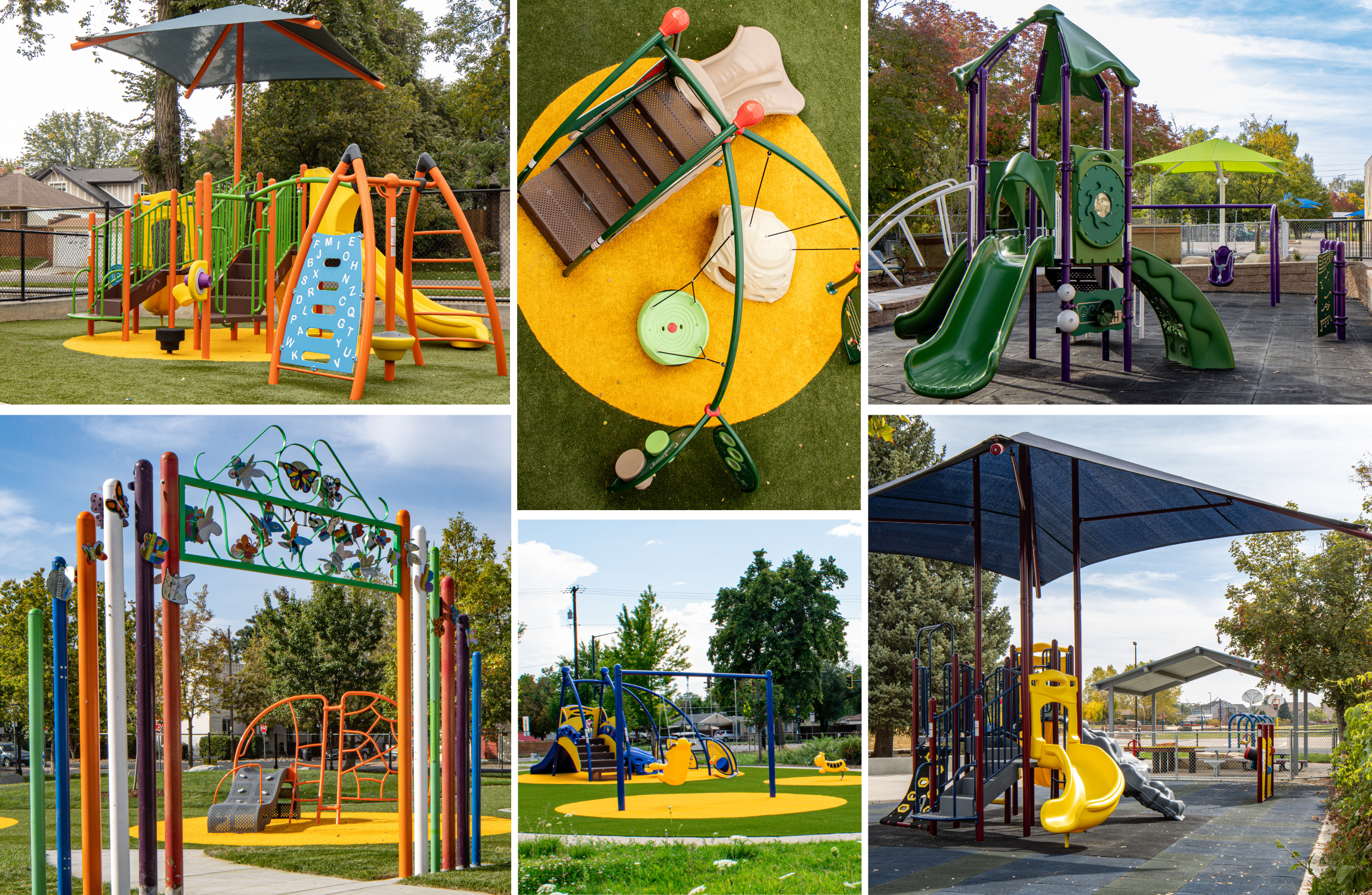
DPS ECE Playground Upgrades
For Denver Public Schools, R&R provided expedited topographic design surveys for 16 early childhood education playground upgrade sites across the city. The work moved alongside design/build delivery, giving the project team the information needed to keep multiple school sites progressing at the same time.
This is the type of project where early survey coordination can make or break the schedule. When multiple campuses are moving at once, accurate site information helps the design and construction teams avoid starting behind.

Monterey Community School
At Monterey Community School, the project included a school addition, new parking lot, playground, tennis courts, soccer field, stormwater management, and associated storm sewer, sanitary sewer, and water infrastructure. R&R also supported approvals through Mapleton School District, Adams County, and the State of Colorado. The project required close coordination with the contractor, architect, and landscape architect to help construction start on a tight schedule.
This is where civil engineering becomes more than a plan set. It becomes a practical coordination tool. For Monterey, R&R also provided cost-saving design strategies, including limited storm sewer piping and grading iterations to help balance the site and reduce sitework costs.

Adams 12 Five Star Stadium
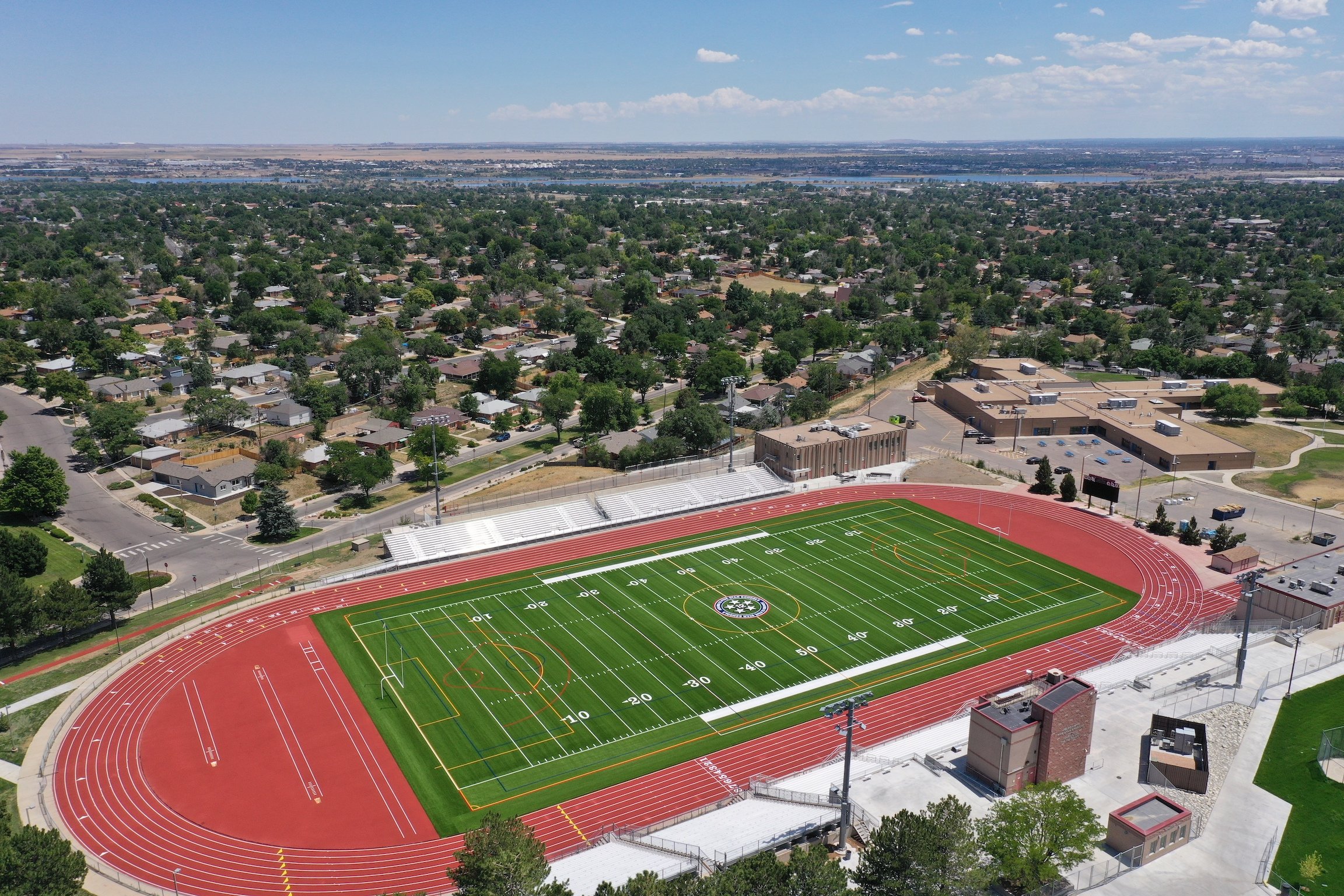
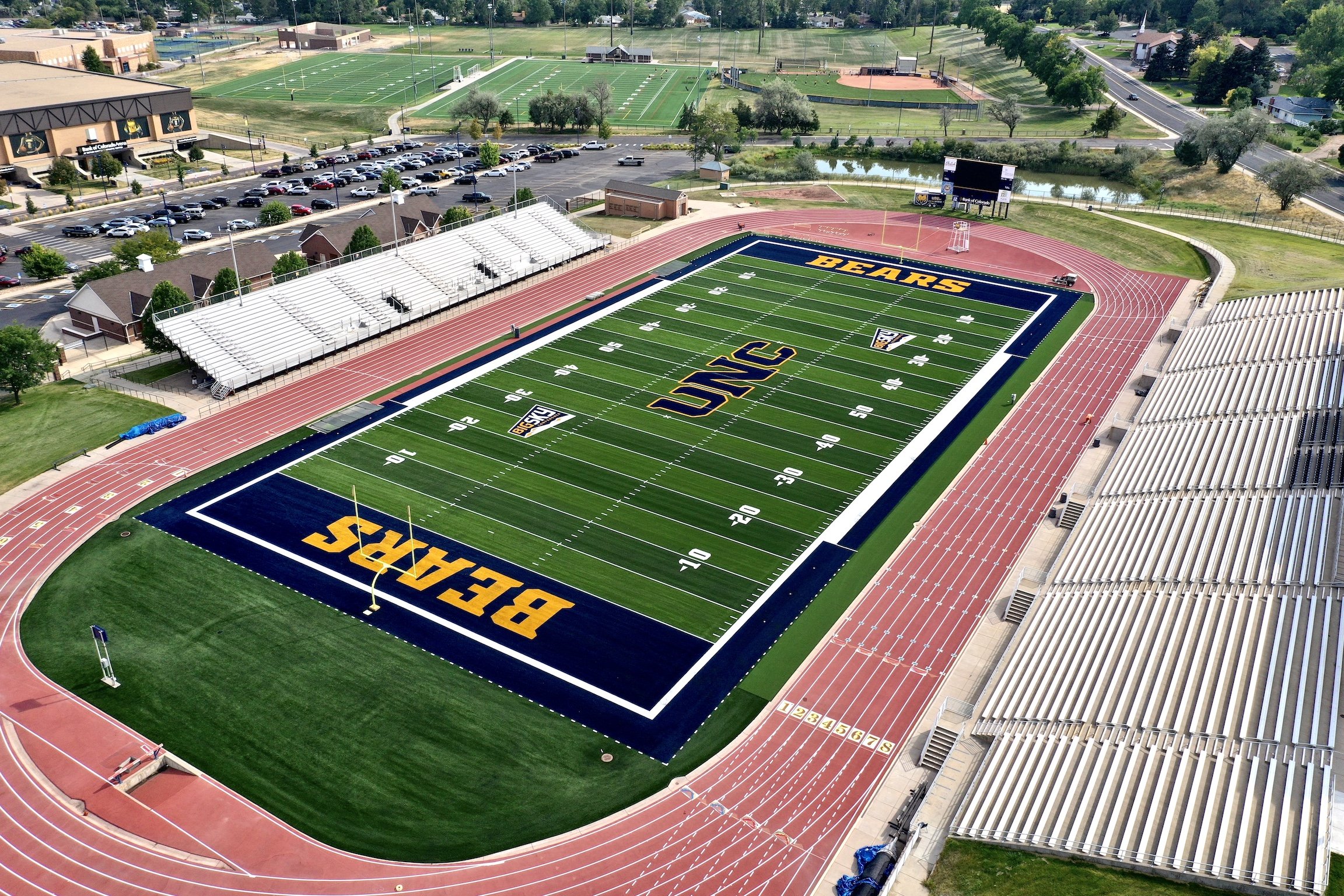
R&R worked with Adams 12 Five Star Schools to revamp the Five Star Stadium running track and multi-use game field in Thornton. R&R provided site investigation and analysis of the existing track and field conditions, civil engineering design for remediation and upgrades, geotechnical investigation management, and construction management assistance.
For school boards and decision-makers planning education stadium improvements, athletic field renovations, or track and field upgrades, this kind of early investigation matters. Field performance, drainage, grading, turf systems, existing conditions, and construction sequencing all affect whether a project can be delivered within a short school or athletic calendar.
“Adams 12 partnered with R&R Engineering to improve and replace our track and field at Five Star Stadium. Todd Smith with R&R exceed our expectations with his professionalism, responsiveness, exceptional communication, accuracy, and ease of working with.”
Why This Work Requires Experience
Education projects leave very little room for schedule surprises. School calendars, campus access, student safety, athletic seasons, public approvals, existing infrastructure, and contractor availability all have to be coordinated before construction begins.
That is what makes experience matter.
R&R brings a practical understanding of the challenges that shape school construction projects, education facility improvements, athletic field renovations, and campus site work. From early survey and civil design through construction staking and field coordination, our team helps education clients identify issues early, communicate clearly, and keep projects moving toward the summer window.
Whether the work involves a playground, parking lot, athletic field, stadium improvement, building addition, or larger campus project, the goal is the same: start with the right information, reduce risk, and be ready when campus access opens up.